Trail running is not defined by kilometres alone. Surface, climbing, weather, navigation and the ability to eat while moving can make the same distance very different from a road race.
Baltic events often combine roots, sand, mud and fast weather changes. Preparation should reproduce those demands rather than simply add weekly distance.
Key points
Train time on feet and terrain, not only kilometre pace.
Rehearse fuel and fluid during long trail sessions with race equipment.
On descents prioritise control, vision and cadence before speed.
Climbs and technical ground
Add one focused hill or strength-endurance session each week. Choose long-run routes with a similar amount of climbing and surface mix to the event. Brisk hiking is often more economical than running on steep slopes and should be practised.
On descents look several steps ahead, shorten the stride and keep the knees responsive. Increase technical speed gradually; the final part of a tired long run is a useful test of technique and equipment.
Fuel, fluid and gut training
For efforts beyond 90 minutes, plan regular carbohydrate. Around 30–60 g per hour is a practical starting range; higher targets for very long events need progressive gut training. Count gels, drinks and bars together.
Intensity varies on trails, so solid food is often easiest on a gentle section or while hiking uphill. Match fluid to conditions and sweat rate; cold air does not stop sweating under a jacket.
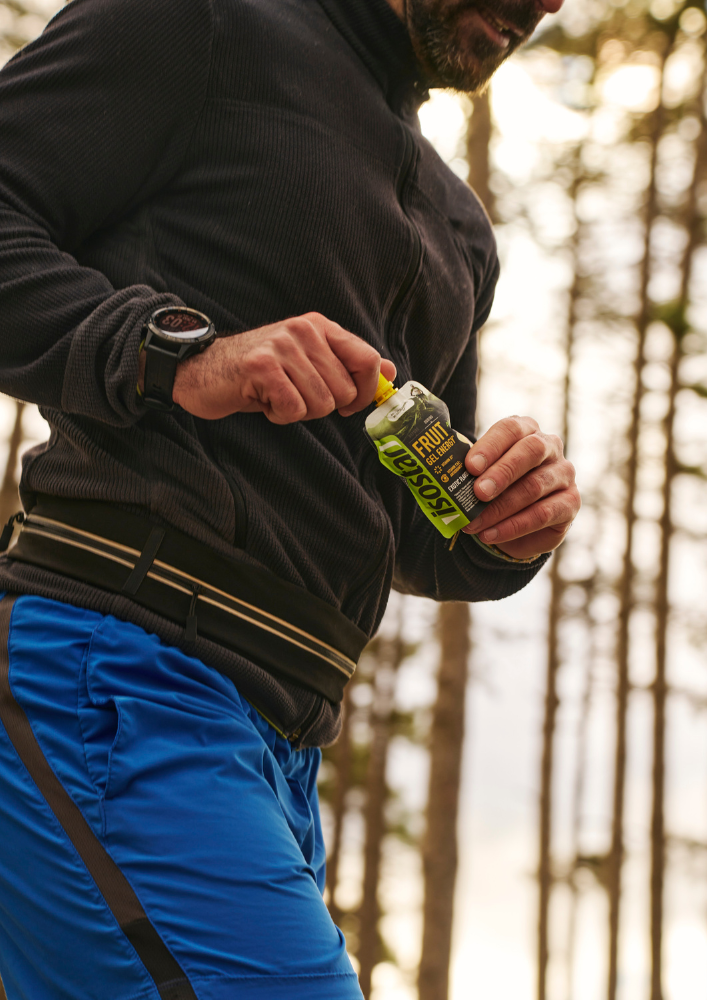
Athlete using an Isostar energy product during training
Equipment for Baltic conditions
Select shoes for the actual surface and your foot rather than lug depth alone. Mud needs grip, while a long hard section can make an aggressive shoe tiring. Test socks, vest, flasks and anti-chafe treatment in wet training.
Mandatory kit is a minimum. In spring and autumn, a wind layer, gloves and dry spare layer can matter more than saving a few grams. A phone and watch route do not replace attention to course markings.
Race-week checklist
Reduce volume while retaining a few short intensity cues. Check the GPX, elevation, aid stations and forecast. Divide fuel into 20–30 minute blocks and carry one spare serving without introducing a new product.
Sharp pain, loss of coordination, repeated vomiting or confusion are reasons to stop and seek event or medical help, not symptoms to “push through”.
A Baltic trail rehearsal
Three or four weeks before the event, complete one controlled rehearsal on similar terrain. Use the same vest, shoes, flasks, breakfast and hourly fuel target without running the full race distance.
Record where wrappers were difficult, whether drink remained accessible, how wet feet felt and when the stomach changed. Alter one detail in the next long session. This finds equipment and nutrition failures before the start line.
Official Isostar / Nutrition & Santé image used by INTERVALS under its distribution agreement.
Author: INTERVALS editorial team. This content was localised and expanded for Baltic athletes from authorised Isostar / Nutrition & Santé material. Scientific claims were checked against the cited primary sources. Last reviewed: 21 August 2026.
Cookie settings
We use cookies to keep the site working, measure visits, and tailor marketing. Read more
Cookie settings
We use cookies to keep the site working, measure visits, and tailor marketing. Read more
Necessary cookies✓
Necessary cookies
Required for core site functionality and always enabled.
Always on
Performance
Help us understand how visitors use the site and where to improve it.
Targeting
Used for ad measurement and personalization.
Necessary cookies
Name
Provider / Scope
Description
intervals_consent
Intervals Consent
Stores the visitor consent choice and schema version.
wp_woocommerce_session_*
WooCommerce
Keeps the cart and checkout session alive between requests.
woocommerce_cart_hash
WooCommerce
Tracks cart changes so the storefront knows when fragments must refresh.
woocommerce_items_in_cart
WooCommerce
Signals whether the visitor currently has items in cart.
intervals_delivery_country
Intervals Market Switcher
Stores the visitor-selected delivery country so the storefront and checkout can preserve that choice across pages.
isl_post_login_redirect
Intervals Social Login
Temporarily stores the return URL for social login so the user can be redirected back to the requested page.
Performance
Name
Provider / Scope
Description
sbjs_*
SourceBuster / WooCommerce attribution
Stores attribution and visit-source data used for marketing and campaign analysis.
intervals_utm_*
Intervals Marketing
Stores UTM campaign parameters for attribution, campaign analysis, and reporting.
intervals_first_visit
Intervals Marketing
Stores first-visit timestamp for attribution/reporting.
intervals_referrer
Intervals Marketing
Stores the referring source for attribution and reporting.
intervals_traffic_source
Intervals Marketing
Stores traffic source attribution.
intervals_landing_page
Intervals Marketing
Stores the landing page used for attribution.
intervals_engagement
Intervals Marketing
SessionStorage record that temporarily stores engagement metrics such as page count, scroll depth, and interactions.
intervals_viewed_products
Intervals Marketing
SessionStorage record that stores the list of products viewed in the session for engagement and attribution analysis.
_ga / _ga_*
Google Analytics 4
Distinguishes visitors and helps build aggregate site-usage reports.
Targeting
Name
Provider / Scope
Description
_fbp
Meta / Facebook Pixel
Advertising attribution and audience measurement.
_fbc
Meta / Facebook Pixel
Advertising click attribution.
_gcl_au
Google Ads
Advertising conversion measurement.
IDE
Google Ads / DoubleClick
Third-party ad personalization and conversion attribution.
test_cookie
Google Ads / DoubleClick
Checks whether the browser supports setting ad-platform cookies.