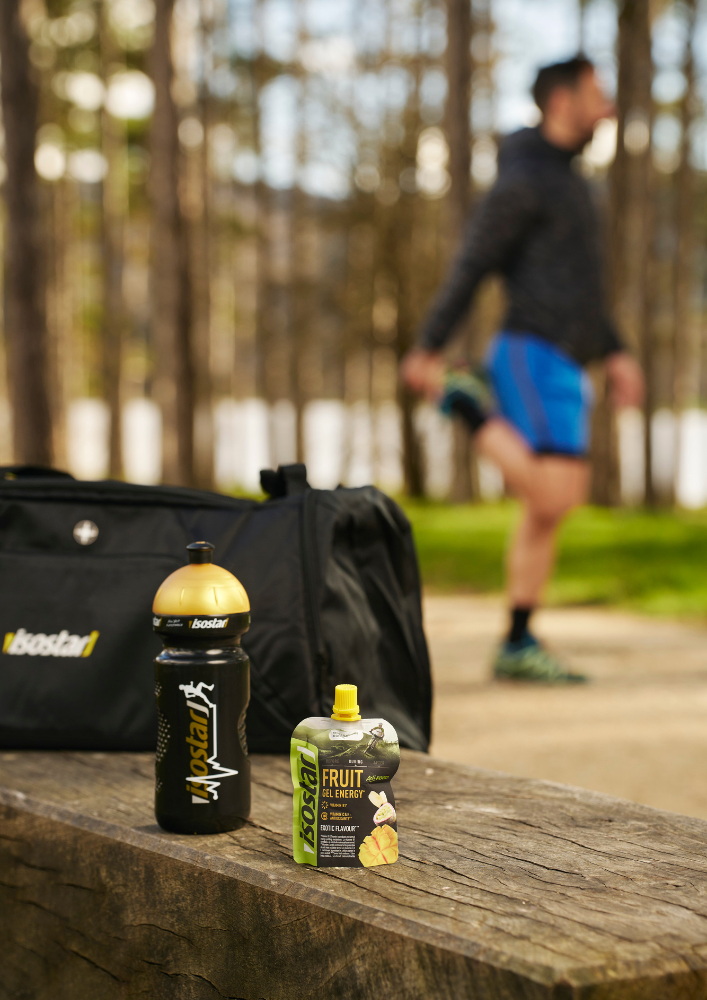
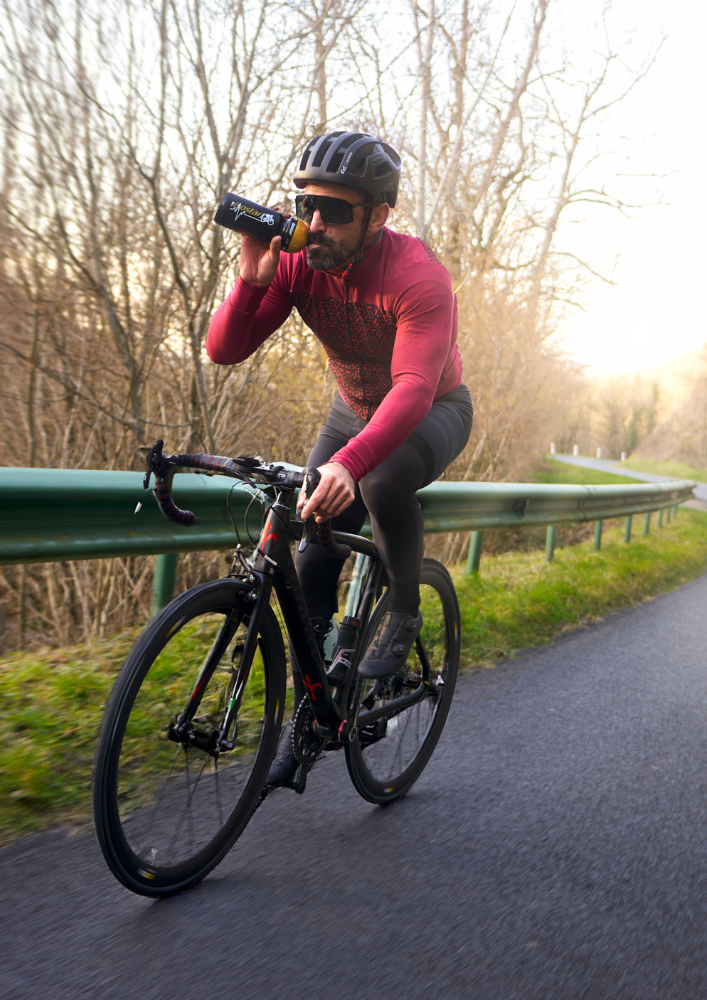
Isostar energy gel and bottle ready for endurance training
An energy gel is a concentrated carbohydrate source. An isotonic drink supplies fluid, electrolytes and energy at the same time. They can be combined, but only when you count total carbohydrate and keep enough fluid in the plan.
The common mistake is to treat every item separately. A gel, sweet drink and bar together may provide far more carbohydrate than the gut has been trained to absorb.
Key points
Count carbohydrate from every source.
Take most gels with water.
Test a new plan in training first.
When is fuel during exercise useful?
Extra carbohydrate is often unnecessary for an easy session lasting up to about an hour. As duration and intensity rise, regular carbohydrate intake can help maintain work rate. A practical starting point for 1–2.5 hours is often 30–60 g per hour. Trained athletes in very long events sometimes use more, with multiple carbohydrate types.
These are not compulsory targets. A smaller athlete, a lower intensity or a sensitive gut may require less. Start with the smallest amount that matches the task.
A simple combination formula
Choose an hourly target, for example 45 g carbohydrate.
Read the labels: if the bottle has 25 g and the gel 20 g, you are already at 45 g.
Schedule the gel before your usual energy dip, not after you have already “hit the wall”.
Take gels labelled for use with water with several mouthfuls of plain water.
If the drink is your main fluid source, do not mix it stronger than directed. In heat, fluid needs may rise faster than carbohydrate needs, so a separate bottle of water can be useful.
Sports nutrition plan with cutlery, scales and measuring tape
Examples for running and cycling
90-minute run
For a hard session, one gel around 35–45 minutes with water may be enough. If the bottle already contains carbohydrate, check whether the gel is still required.
Three-hour ride
Smaller portions every 20–30 minutes are usually easier to tolerate than a large hourly dose. Combine drink, gel and an easy-to-chew bar while keeping the approximate hourly total consistent.
Marathon
Match the plan to aid stations. Taking a gel just before a station makes it easier to follow with water. Do not depend on an unfamiliar on-course drink that you have never tested.
What to do when the stomach turns
Reduce intensity and pause concentrated carbohydrate for a while; small mouthfuls of water may be easier to tolerate. Afterwards, record how much and how quickly you consumed, the pace and the weather. The problem is often the total dose or too little water, not a single product.
Repeated severe pain, bloody diarrhoea, fainting or persistent vomiting should never be “trained through”; seek medical help.
Race-plan checklist
Write carbohydrate grams and caffeine, if present, on each pack.
Plan in 20–30 minute blocks rather than simply “gels per hour”.
Mark where plain water and the organiser’s sports drink are available.
Carry one reserve serving without consuming it merely because it is there.
In heat, separate the fluid plan from the energy plan.
Make sure packs can be opened with wet or cold hands and that wrappers have a secure pocket. These details often determine whether a good paper plan works in a real event.
Official Isostar / Nutrition & Santé image used by INTERVALS under its distribution agreement.
Author: INTERVALS editorial team. This content was localised and expanded for Baltic athletes from authorised Isostar / Nutrition & Santé material. Scientific claims were checked against the cited primary sources. Last reviewed: 21 August 2026.
Cookie settings
We use cookies to keep the site working, measure visits, and tailor marketing. Read more
Cookie settings
We use cookies to keep the site working, measure visits, and tailor marketing. Read more
Necessary cookies✓
Necessary cookies
Required for core site functionality and always enabled.
Always on
Performance
Help us understand how visitors use the site and where to improve it.
Targeting
Used for ad measurement and personalization.
Necessary cookies
Name
Provider / Scope
Description
intervals_consent
Intervals Consent
Stores the visitor consent choice and schema version.
wp_woocommerce_session_*
WooCommerce
Keeps the cart and checkout session alive between requests.
woocommerce_cart_hash
WooCommerce
Tracks cart changes so the storefront knows when fragments must refresh.
woocommerce_items_in_cart
WooCommerce
Signals whether the visitor currently has items in cart.
intervals_delivery_country
Intervals Market Switcher
Stores the visitor-selected delivery country so the storefront and checkout can preserve that choice across pages.
isl_post_login_redirect
Intervals Social Login
Temporarily stores the return URL for social login so the user can be redirected back to the requested page.
Performance
Name
Provider / Scope
Description
sbjs_*
SourceBuster / WooCommerce attribution
Stores attribution and visit-source data used for marketing and campaign analysis.
intervals_utm_*
Intervals Marketing
Stores UTM campaign parameters for attribution, campaign analysis, and reporting.
intervals_first_visit
Intervals Marketing
Stores first-visit timestamp for attribution/reporting.
intervals_referrer
Intervals Marketing
Stores the referring source for attribution and reporting.
intervals_traffic_source
Intervals Marketing
Stores traffic source attribution.
intervals_landing_page
Intervals Marketing
Stores the landing page used for attribution.
intervals_engagement
Intervals Marketing
SessionStorage record that temporarily stores engagement metrics such as page count, scroll depth, and interactions.
intervals_viewed_products
Intervals Marketing
SessionStorage record that stores the list of products viewed in the session for engagement and attribution analysis.
_ga / _ga_*
Google Analytics 4
Distinguishes visitors and helps build aggregate site-usage reports.
Targeting
Name
Provider / Scope
Description
_fbp
Meta / Facebook Pixel
Advertising attribution and audience measurement.
_fbc
Meta / Facebook Pixel
Advertising click attribution.
_gcl_au
Google Ads
Advertising conversion measurement.
IDE
Google Ads / DoubleClick
Third-party ad personalization and conversion attribution.
test_cookie
Google Ads / DoubleClick
Checks whether the browser supports setting ad-platform cookies.