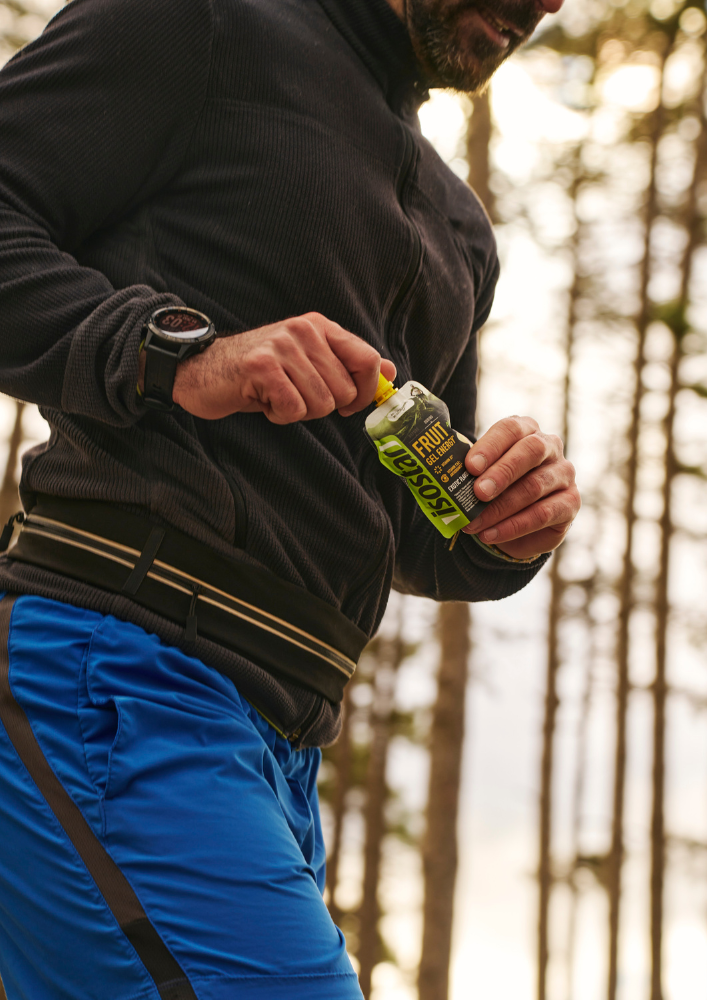
Athlete opening an Isostar fruit energy gel during endurance training
The digestive system can adapt to the fluid and carbohydrate intake planned for a long event. Gut training does not mean ignoring pain. It means progressively and repeatedly rehearsing the exact nutrition plan you intend to use on race day.
In a small randomised study, two weeks of gut training reduced gastrointestinal symptoms and improved an exercise test in runners. The sample was small, so treat this as a practical method with individual responses, not a guarantee.
Key points
Train the race plan, not random products.
Increase only one variable at a time.
Record dose, timing, intensity and symptoms.
Why the gut protests in competition
Hard exercise redirects blood flow towards working muscle, movement mechanically disturbs the gut, and heat or stress can amplify symptoms. Adding a large, unfamiliar carbohydrate dose increases the risk further.
The pre-race meal also matters. Very high fibre, fat or protein shortly before exercise may slow gastric emptying for some athletes. There is no universal banned-food list; personal testing matters.
A practical four-week progression
Week 1: establish a baseline
In one long easy session, try 30 g carbohydrate per hour with familiar fluid. Score symptoms from 0 to 10.
Week 2: change the frequency
Keep the total amount but divide it into smaller servings every 20–30 minutes. This helps separate a dose problem from a serving-size problem.
Week 3: move towards race demand
Increase only one step, for example 10–15 g per hour. Do not change product, concentration and intensity at the same time.
Week 4: dress rehearsal
Use race breakfast, equipment, drink and product order at a similar time of day. The goal is predictability, not a maximum dose.
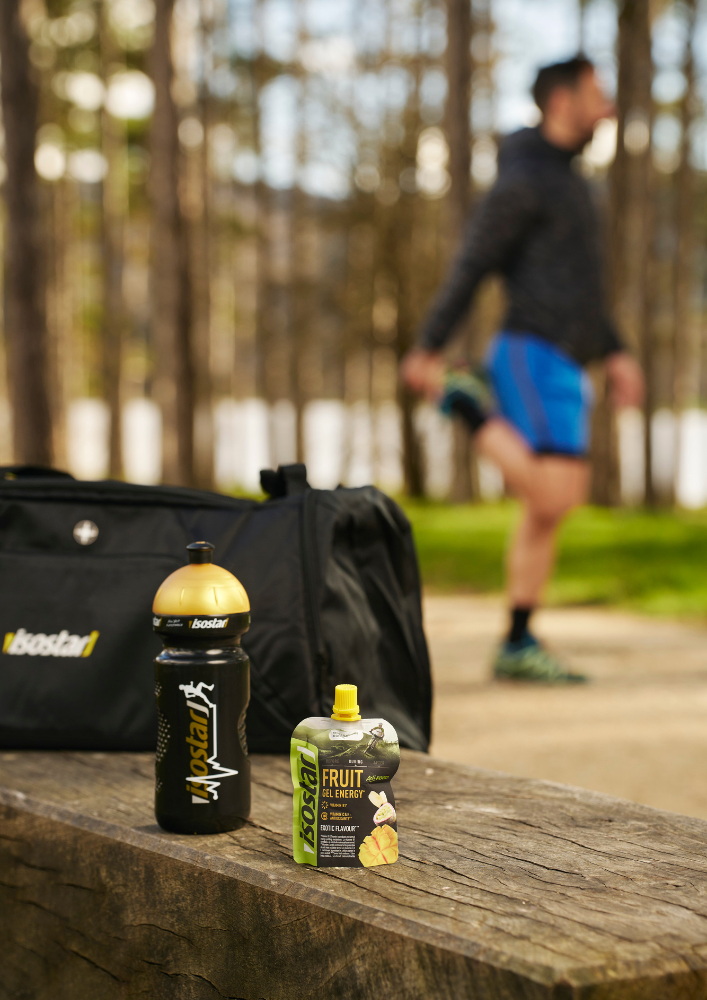
Isostar energy gel and bottle ready for endurance training
What to record in a gut-training diary
duration, intensity and temperature;
food eaten 3–4 hours before the start;
timing and carbohydrate grams of every product;
fluid consumed;
fullness, belching, cramps, nausea and toilet urgency;
the single change you will make next time.
Three or four comparable sessions reveal more than one bad day.
When to stop the experiment
Mild fullness can help identify tolerance, but severe or increasing pain is not the aim. Stop and assess if there is repeated vomiting, bloody stool, dizziness, fainting or symptoms that remain outside exercise.
If you have a diagnosed gastrointestinal condition, food allergy or a history of major race problems, build the plan with a doctor or qualified sports dietitian.
Separating a product, dose or intensity problem
If symptoms appear only at race pace and not during an easy long session, the interaction between intensity and dose may matter more than the product itself. Repeat the same dose at lower intensity; on another day keep intensity but reduce the serving. Changing one factor produces a clearer answer.
Compare fluid and temperature too. The same gel without enough water or in heat may feel completely different. Successful gut training finishes with a written, simple protocol: pre-race food, what you carry, when each item is used and what the fallback is.
Official Isostar / Nutrition & Santé image used by INTERVALS under its distribution agreement.
Author: INTERVALS editorial team. This content was localised and expanded for Baltic athletes from authorised Isostar / Nutrition & Santé material. Scientific claims were checked against the cited primary sources. Last reviewed: 21 August 2026.
Cookie settings
We use cookies to keep the site working, measure visits, and tailor marketing. Read more
Cookie settings
We use cookies to keep the site working, measure visits, and tailor marketing. Read more
Necessary cookies✓
Necessary cookies
Required for core site functionality and always enabled.
Always on
Performance
Help us understand how visitors use the site and where to improve it.
Targeting
Used for ad measurement and personalization.
Necessary cookies
Name
Provider / Scope
Description
intervals_consent
Intervals Consent
Stores the visitor consent choice and schema version.
wp_woocommerce_session_*
WooCommerce
Keeps the cart and checkout session alive between requests.
woocommerce_cart_hash
WooCommerce
Tracks cart changes so the storefront knows when fragments must refresh.
woocommerce_items_in_cart
WooCommerce
Signals whether the visitor currently has items in cart.
intervals_delivery_country
Intervals Market Switcher
Stores the visitor-selected delivery country so the storefront and checkout can preserve that choice across pages.
isl_post_login_redirect
Intervals Social Login
Temporarily stores the return URL for social login so the user can be redirected back to the requested page.
Performance
Name
Provider / Scope
Description
sbjs_*
SourceBuster / WooCommerce attribution
Stores attribution and visit-source data used for marketing and campaign analysis.
intervals_utm_*
Intervals Marketing
Stores UTM campaign parameters for attribution, campaign analysis, and reporting.
intervals_first_visit
Intervals Marketing
Stores first-visit timestamp for attribution/reporting.
intervals_referrer
Intervals Marketing
Stores the referring source for attribution and reporting.
intervals_traffic_source
Intervals Marketing
Stores traffic source attribution.
intervals_landing_page
Intervals Marketing
Stores the landing page used for attribution.
intervals_engagement
Intervals Marketing
SessionStorage record that temporarily stores engagement metrics such as page count, scroll depth, and interactions.
intervals_viewed_products
Intervals Marketing
SessionStorage record that stores the list of products viewed in the session for engagement and attribution analysis.
_ga / _ga_*
Google Analytics 4
Distinguishes visitors and helps build aggregate site-usage reports.
Targeting
Name
Provider / Scope
Description
_fbp
Meta / Facebook Pixel
Advertising attribution and audience measurement.
_fbc
Meta / Facebook Pixel
Advertising click attribution.
_gcl_au
Google Ads
Advertising conversion measurement.
IDE
Google Ads / DoubleClick
Third-party ad personalization and conversion attribution.
test_cookie
Google Ads / DoubleClick
Checks whether the browser supports setting ad-platform cookies.