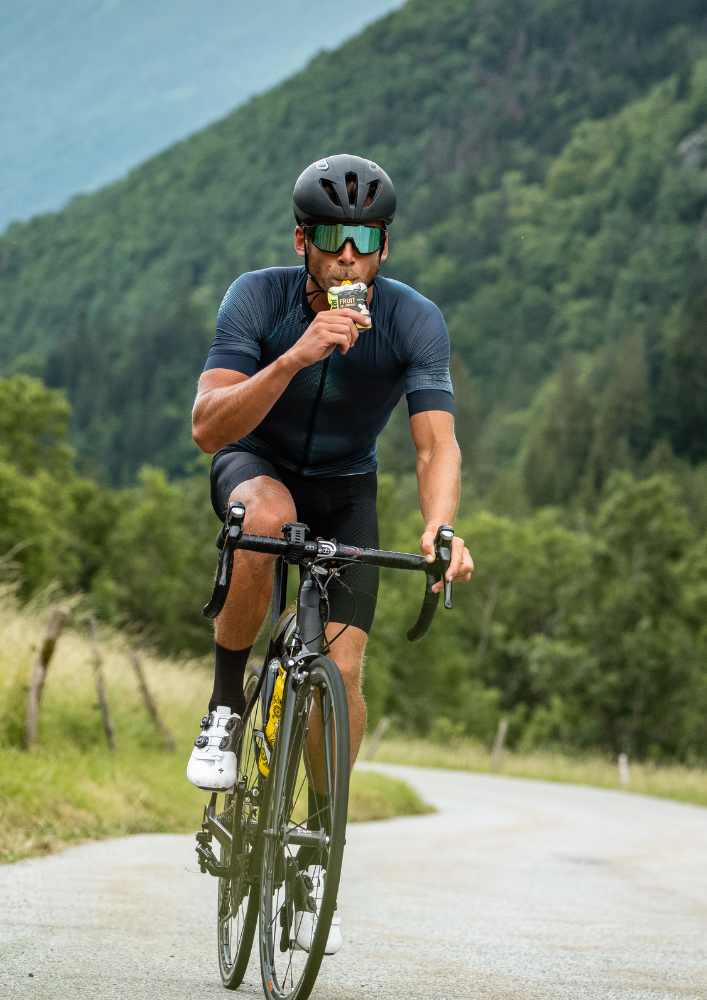
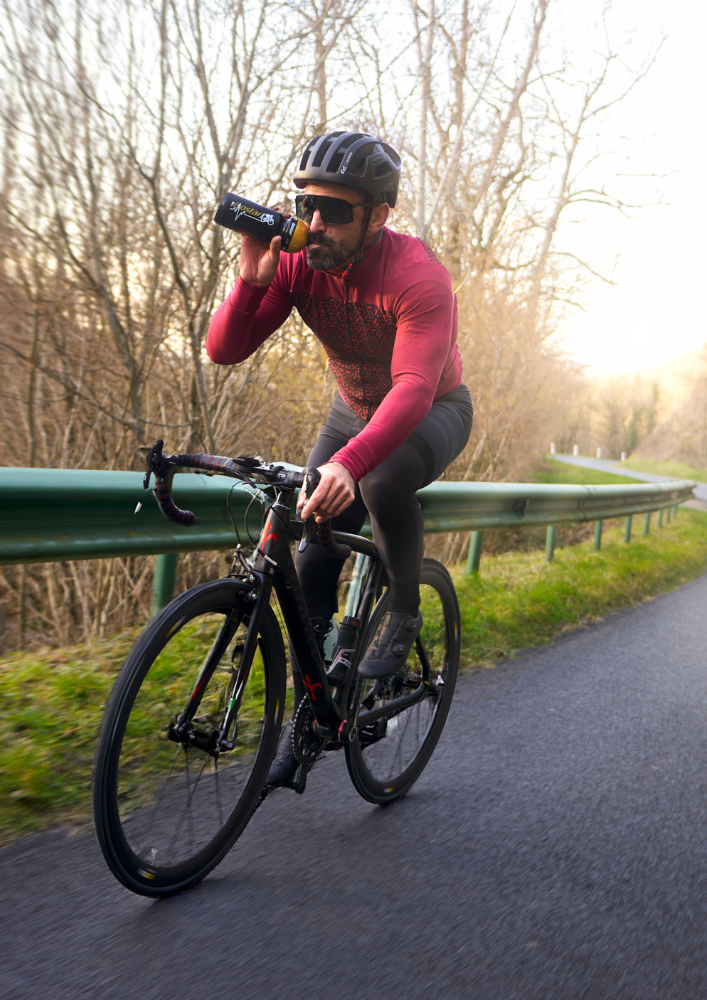
Cyclist using an Isostar energy gel during a long ride
Glycogen is carbohydrate stored in muscle and liver. Before a long endurance event, stores can be increased by reducing training and raising carbohydrate intake over the final 36–48 hours. This does not mean eating one enormous bowl of pasta the night before.
Studies show that higher carbohydrate intake can increase muscle glycogen, but performance benefits differ between protocols and events. The practical goal is to start well fuelled, with a calm stomach and familiar food.
Key points
Start 36–48 hours before a long event.
Increase carbohydrate, not unlimited total food.
Reduce fibre only if your gut benefits from it.
Who benefits from carbohydrate loading?
It is most relevant to events with continuous or repeated work lasting roughly 90 minutes or more: a marathon, long trail race, gran fondo, triathlon or multi-hour ski event. A short race or easy training session rarely needs a special loading phase.
If your usual diet is low in carbohydrate, a sudden large increase can cause fullness. A gradual rise and easy-to-digest sources are more useful than chasing a theoretical maximum.
How much: a practical rather than absolute target
Classic studies used high intakes, often around 7–10 g carbohydrate per kilogram of body mass per day. In a small 2026 study, 10 g/kg/day for 48 hours produced the largest glycogen rise compared with 6 and 8 g/kg, but only 11 trained athletes took part.
For a 70 kg athlete, 7 g/kg is 490 g carbohydrate—far more than most people imagine. You do not need to force the maximum laboratory dose. If it has not been rehearsed, choose a lower tolerable target and spread it over frequent meals.
Sports nutrition plan with cutlery, scales and measuring tape
A 48-hour example
Two days before
Use porridge, bread and banana at breakfast; rice or potatoes with a modest lean-protein serving at lunch; yoghurt, bread, fruit or a sports bar as snacks; and pasta or rice at dinner. Drink regularly without forcing fluid.
The day before
Keep carbohydrate in each meal but reduce very fatty, spicy and unfamiliar foods. For a sensitive gut, white rice, white bread, peeled potatoes, banana, drinks and small snacks may be easier.
Race morning
Eat a rehearsed breakfast 2–4 hours before the start. In the final hour, use only a small familiar top-up if it is already part of your training plan.
Common mistakes
One huge dinner: loading requires time and several meals.
More fat with more carbohydrate: total energy becomes excessive and digestion slower.
Too much fibre: healthy every day is not always ideal immediately before a race for a sensitive gut.
New products: race week is not a tasting session.
Panicking about body mass: glycogen binds water, so a small temporary increase is expected.
A portion check without obsessive weighing
If you do not want to weigh every gram, start with a carbohydrate source in every main meal plus 2–3 snacks, while reducing very fatty extras. On one rehearsal weekend, estimate the total so you learn whether your idea of “high carbohydrate” actually approaches the target.
Liquid carbohydrate and sports foods can help when normal food volume becomes too large, but they must be familiar. People with diabetes, reactive hypoglycaemia or gastrointestinal disease should not build a high-carbohydrate protocol without medical or dietetic advice.
Official Isostar / Nutrition & Santé image used by INTERVALS under its distribution agreement.
Author: INTERVALS editorial team. This content was localised and expanded for Baltic athletes from authorised Isostar / Nutrition & Santé material. Scientific claims were checked against the cited primary sources. Last reviewed: 21 August 2026.
Cookie settings
We use cookies to keep the site working, measure visits, and tailor marketing. Read more
Cookie settings
We use cookies to keep the site working, measure visits, and tailor marketing. Read more
Necessary cookies✓
Necessary cookies
Required for core site functionality and always enabled.
Always on
Performance
Help us understand how visitors use the site and where to improve it.
Targeting
Used for ad measurement and personalization.
Necessary cookies
Name
Provider / Scope
Description
intervals_consent
Intervals Consent
Stores the visitor consent choice and schema version.
wp_woocommerce_session_*
WooCommerce
Keeps the cart and checkout session alive between requests.
woocommerce_cart_hash
WooCommerce
Tracks cart changes so the storefront knows when fragments must refresh.
woocommerce_items_in_cart
WooCommerce
Signals whether the visitor currently has items in cart.
intervals_delivery_country
Intervals Market Switcher
Stores the visitor-selected delivery country so the storefront and checkout can preserve that choice across pages.
isl_post_login_redirect
Intervals Social Login
Temporarily stores the return URL for social login so the user can be redirected back to the requested page.
Performance
Name
Provider / Scope
Description
sbjs_*
SourceBuster / WooCommerce attribution
Stores attribution and visit-source data used for marketing and campaign analysis.
intervals_utm_*
Intervals Marketing
Stores UTM campaign parameters for attribution, campaign analysis, and reporting.
intervals_first_visit
Intervals Marketing
Stores first-visit timestamp for attribution/reporting.
intervals_referrer
Intervals Marketing
Stores the referring source for attribution and reporting.
intervals_traffic_source
Intervals Marketing
Stores traffic source attribution.
intervals_landing_page
Intervals Marketing
Stores the landing page used for attribution.
intervals_engagement
Intervals Marketing
SessionStorage record that temporarily stores engagement metrics such as page count, scroll depth, and interactions.
intervals_viewed_products
Intervals Marketing
SessionStorage record that stores the list of products viewed in the session for engagement and attribution analysis.
_ga / _ga_*
Google Analytics 4
Distinguishes visitors and helps build aggregate site-usage reports.
Targeting
Name
Provider / Scope
Description
_fbp
Meta / Facebook Pixel
Advertising attribution and audience measurement.
_fbc
Meta / Facebook Pixel
Advertising click attribution.
_gcl_au
Google Ads
Advertising conversion measurement.
IDE
Google Ads / DoubleClick
Third-party ad personalization and conversion attribution.
test_cookie
Google Ads / DoubleClick
Checks whether the browser supports setting ad-platform cookies.