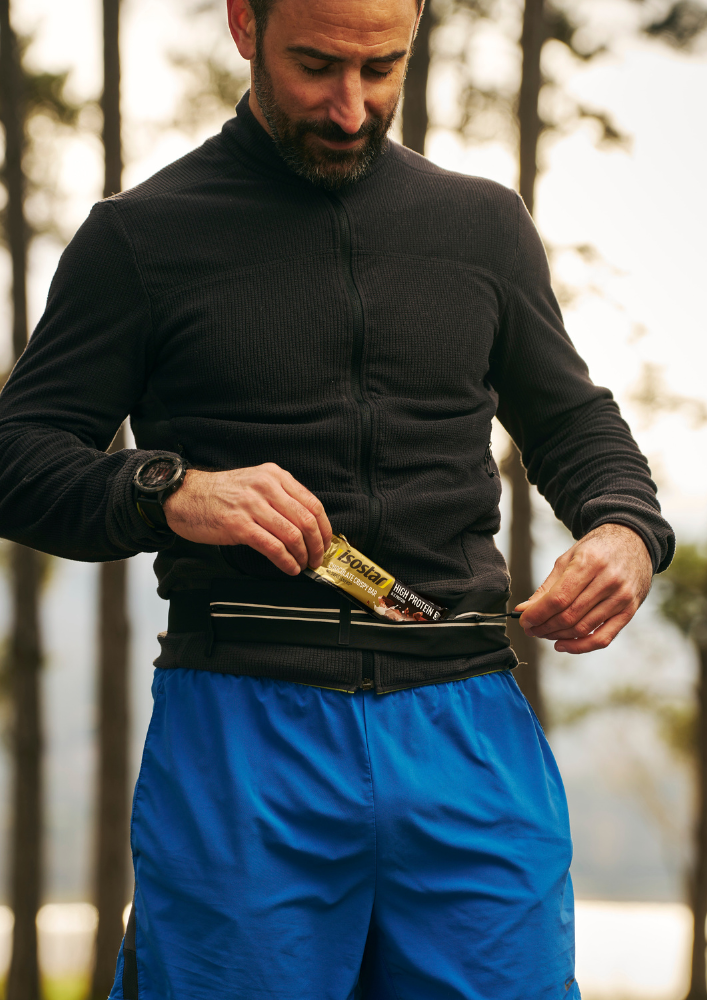
Athlete placing an Isostar energy bar in a waist-belt pocket
An energy bar is a convenient carbohydrate source on the bike, but it is not automatically needed for every ride. A short easy session may require only a normal pre-ride meal; a long ride needs a total carbohydrate target and a texture that can be chewed at the planned intensity.
Keep the plan simple: know the grams in each serving, divide them across time and combine them with fluid.
Key points
Count carbohydrate from bars, gels and drinks together.
Use firmer food on calmer sections and take it with fluid.
Rehearse a long-ride plan in at least two comparable training sessions.
When a bar is useful
Extra energy is rarely the priority for an easy 60–75 minute ride. One serving may help during a hard 90-minute session, while a three- to five-hour ride requires regular intake. Around 30–60 g carbohydrate per hour is a practical starting point; larger amounts require training.
A bar offers satiety and variety, but a gel or drink can be easier at high intensity. Different formats can share the same hourly target.
Read the label and calculate portions
Check carbohydrate per bar rather than the word “energy”. If one bar supplies 30 g, half every 30 minutes equals about 30 g per hour. Add drink and gel carbohydrate instead of treating them as extras.
Very fatty, fibre-rich or dense protein bars can slow gastric emptying for some riders. Race fuel should prioritise tolerance over the longest ingredient list.
Cyclist planning nutrition for a long ride
Ninety minutes, three hours and gran fondo
Ninety minutes: on a hard day, one serving around the middle. Three hours: start in the first hour and divide 30–60 g/h into small servings. Gran fondo: place solid food around climbs and aid stations, then switch to an easier format late in the event if that is better tolerated.
The 2026 Isostar ten-week cycling plan offers a useful principle: long sessions are nutrition rehearsals. Test one change per week rather than everything on race day.
Handling and safety
Open the wrapper before a technical descent, divide the bar and store it within easy reach. Do not eat when both hands and full attention are needed. In heat, separate energy requirements from fluid requirements.
Repeated vomiting, severe abdominal pain, confusion or inability to retain fluid is not a normal energy dip. Stop safely and seek help when needed.
Plan the jersey pockets
Pack products in use order: first-hour fuel in one pocket, later servings in another and the spare separately. Mark carbohydrate grams and only pre-tear a wrapper when the food cannot fall out.
Count what returns home. If half the plan is regularly uneaten, decide whether the dose was excessive, the texture too firm or intensity left no safe moment to eat. Improve execution, not only the spreadsheet.
Official Isostar / Nutrition & Santé image used by INTERVALS under its distribution agreement.
Author: INTERVALS editorial team. This content was localised and expanded for Baltic athletes from authorised Isostar / Nutrition & Santé material. Scientific claims were checked against the cited primary sources. Last reviewed: 21 August 2026.
Cookie settings
We use cookies to keep the site working, measure visits, and tailor marketing. Read more
Cookie settings
We use cookies to keep the site working, measure visits, and tailor marketing. Read more
Necessary cookies✓
Necessary cookies
Required for core site functionality and always enabled.
Always on
Performance
Help us understand how visitors use the site and where to improve it.
Targeting
Used for ad measurement and personalization.
Necessary cookies
Name
Provider / Scope
Description
intervals_consent
Intervals Consent
Stores the visitor consent choice and schema version.
wp_woocommerce_session_*
WooCommerce
Keeps the cart and checkout session alive between requests.
woocommerce_cart_hash
WooCommerce
Tracks cart changes so the storefront knows when fragments must refresh.
woocommerce_items_in_cart
WooCommerce
Signals whether the visitor currently has items in cart.
intervals_delivery_country
Intervals Market Switcher
Stores the visitor-selected delivery country so the storefront and checkout can preserve that choice across pages.
isl_post_login_redirect
Intervals Social Login
Temporarily stores the return URL for social login so the user can be redirected back to the requested page.
Performance
Name
Provider / Scope
Description
sbjs_*
SourceBuster / WooCommerce attribution
Stores attribution and visit-source data used for marketing and campaign analysis.
intervals_utm_*
Intervals Marketing
Stores UTM campaign parameters for attribution, campaign analysis, and reporting.
intervals_first_visit
Intervals Marketing
Stores first-visit timestamp for attribution/reporting.
intervals_referrer
Intervals Marketing
Stores the referring source for attribution and reporting.
intervals_traffic_source
Intervals Marketing
Stores traffic source attribution.
intervals_landing_page
Intervals Marketing
Stores the landing page used for attribution.
intervals_engagement
Intervals Marketing
SessionStorage record that temporarily stores engagement metrics such as page count, scroll depth, and interactions.
intervals_viewed_products
Intervals Marketing
SessionStorage record that stores the list of products viewed in the session for engagement and attribution analysis.
_ga / _ga_*
Google Analytics 4
Distinguishes visitors and helps build aggregate site-usage reports.
Targeting
Name
Provider / Scope
Description
_fbp
Meta / Facebook Pixel
Advertising attribution and audience measurement.
_fbc
Meta / Facebook Pixel
Advertising click attribution.
_gcl_au
Google Ads
Advertising conversion measurement.
IDE
Google Ads / DoubleClick
Third-party ad personalization and conversion attribution.
test_cookie
Google Ads / DoubleClick
Checks whether the browser supports setting ad-platform cookies.