Athlete performing strength training with dumbbells
Muscle grows when progressive resistance training provides the signal and the diet supplies enough energy and protein. A protein shake can be convenient, but it cannot replace consistent training.
The best programme is not the one that creates the most soreness in a single day. It is the one that lets you improve repetitions, load or movement quality for months while still recovering.
Key points
Train each muscle group regularly and progressively.
Distribute protein across 3–5 substantial meals.
Sleep and energy intake determine whether training can be repeated.
Resistance training provides the main signal
Build the programme around movement patterns: a squat or leg press, push, pull, hip extension, and single-limb work. Several work sets in roughly the 6–15 repetition range suit many hypertrophy goals when the final repetitions are challenging and technique remains controlled.
Progress can mean one extra repetition, a small load increase or better control. If nothing improves for weeks while fatigue rises, review the programme and recovery before buying another supplement.
How much protein?
The broader research suggests that about 1.6 g protein per kilogram of body mass per day is often sufficient for resistance-trained people. A practical individual range may be around 1.4–2.0 g/kg depending on energy intake, experience and goals. For a 70 kg athlete, 1.6 g/kg equals 112 g per day.
The daily total matters more than an “anabolic minute” after training. Distribution still helps: 3–5 meals with a meaningful protein serving are generally more practical than eating almost all of it at dinner.
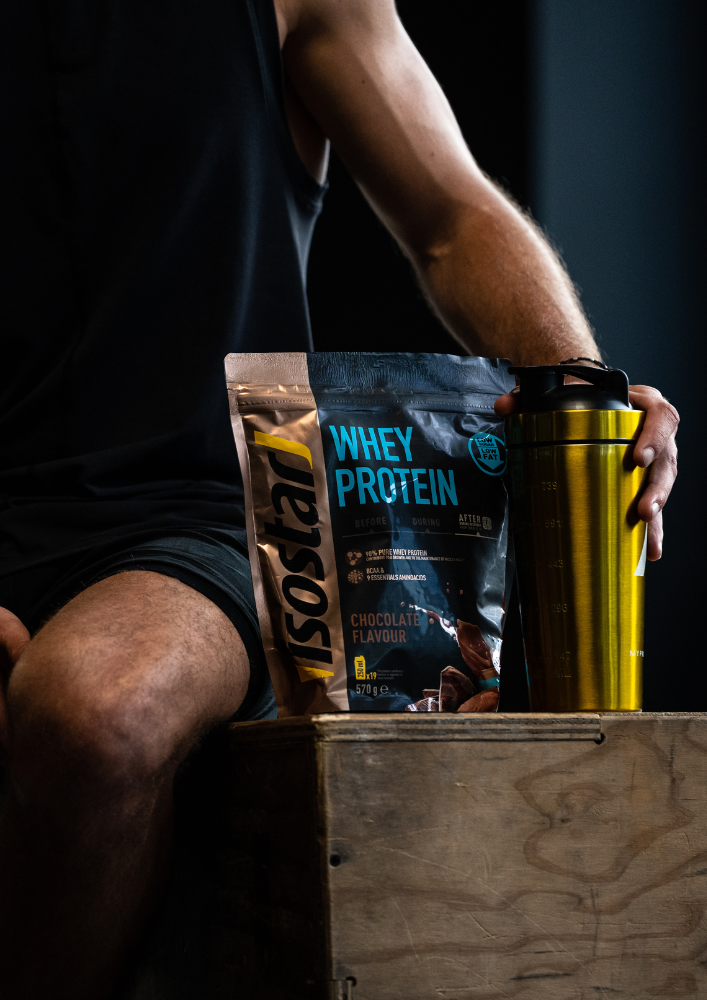
Isostar Whey Protein pack and shaker
Meal distribution and timing
In a randomised trial, an even distribution of protein at breakfast, lunch and dinner produced greater 24-hour muscle-protein synthesis than a pattern heavily weighted to dinner. In practice, include a quality source in each main meal: dairy, eggs, fish, meat, legumes, tofu or a combination.
A normal meal within 1–3 hours after training works well. A shake is useful when appetite or time is limited. Pre-sleep protein can help reach the daily target, but is not compulsory when total intake is already sufficient.
Energy, carbohydrate and recovery
Building tissue requires energy. A small controlled surplus can help, whereas an aggressive “bulk” mainly adds body fat. Carbohydrate supports training quality, especially when resistance-training volume is high.
Keep a regular sleep schedule and allow enough time between hard sessions for the same muscle group. If body mass, strength and measurements do not move for 3–4 weeks, change one variable: slightly increase energy or improve training progression.
What supplements can and cannot do
Protein powder is a convenient form of food, not an essential muscle builder. Choose it by tolerance, protein per serving and ingredients. Creatine monohydrate has a stronger evidence base for supporting strength and lean mass than most “muscle” blends, but it still works only alongside training.
People with kidney disease, pregnancy, a young age or other medical concerns should discuss high protein intakes and supplements with a doctor first.
Measuring progress without misleading conclusions
Weigh under similar conditions several times per week and use a weekly average. Every 2–4 weeks, record waist and target-muscle measurements, photos in consistent light, and working loads in key exercises. Rapid mass gain together with a fast-growing waist usually means the energy surplus is too large.
If strength improves while scale weight pauses, the programme has not necessarily failed. Training experience, glycogen, water and measurement error hide small changes. Make decisions from a 3–4 week trend and adjust one factor at a time.
Official Isostar / Nutrition & Santé image used by INTERVALS under its distribution agreement.
Author: INTERVALS editorial team. This content was localised and expanded for Baltic athletes from authorised Isostar / Nutrition & Santé material. Scientific claims were checked against the cited primary sources. Last reviewed: 21 August 2026.
Cookie settings
We use cookies to keep the site working, measure visits, and tailor marketing. Read more
Cookie settings
We use cookies to keep the site working, measure visits, and tailor marketing. Read more
Necessary cookies✓
Necessary cookies
Required for core site functionality and always enabled.
Always on
Performance
Help us understand how visitors use the site and where to improve it.
Targeting
Used for ad measurement and personalization.
Necessary cookies
Name
Provider / Scope
Description
intervals_consent
Intervals Consent
Stores the visitor consent choice and schema version.
wp_woocommerce_session_*
WooCommerce
Keeps the cart and checkout session alive between requests.
woocommerce_cart_hash
WooCommerce
Tracks cart changes so the storefront knows when fragments must refresh.
woocommerce_items_in_cart
WooCommerce
Signals whether the visitor currently has items in cart.
intervals_delivery_country
Intervals Market Switcher
Stores the visitor-selected delivery country so the storefront and checkout can preserve that choice across pages.
isl_post_login_redirect
Intervals Social Login
Temporarily stores the return URL for social login so the user can be redirected back to the requested page.
Performance
Name
Provider / Scope
Description
sbjs_*
SourceBuster / WooCommerce attribution
Stores attribution and visit-source data used for marketing and campaign analysis.
intervals_utm_*
Intervals Marketing
Stores UTM campaign parameters for attribution, campaign analysis, and reporting.
intervals_first_visit
Intervals Marketing
Stores first-visit timestamp for attribution/reporting.
intervals_referrer
Intervals Marketing
Stores the referring source for attribution and reporting.
intervals_traffic_source
Intervals Marketing
Stores traffic source attribution.
intervals_landing_page
Intervals Marketing
Stores the landing page used for attribution.
intervals_engagement
Intervals Marketing
SessionStorage record that temporarily stores engagement metrics such as page count, scroll depth, and interactions.
intervals_viewed_products
Intervals Marketing
SessionStorage record that stores the list of products viewed in the session for engagement and attribution analysis.
_ga / _ga_*
Google Analytics 4
Distinguishes visitors and helps build aggregate site-usage reports.
Targeting
Name
Provider / Scope
Description
_fbp
Meta / Facebook Pixel
Advertising attribution and audience measurement.
_fbc
Meta / Facebook Pixel
Advertising click attribution.
_gcl_au
Google Ads
Advertising conversion measurement.
IDE
Google Ads / DoubleClick
Third-party ad personalization and conversion attribution.
test_cookie
Google Ads / DoubleClick
Checks whether the browser supports setting ad-platform cookies.