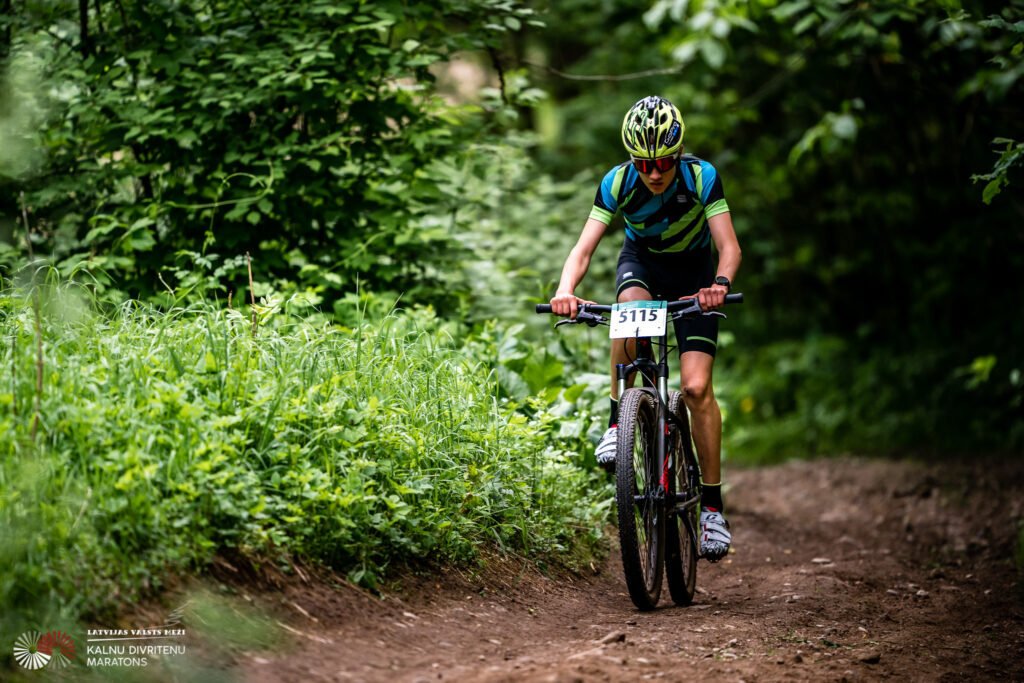
MTB racing in the forests near Sigulda. Photo: AS Latvijas valsts meži (LVM). Avots / source
An MTB or trail-race fuel plan must work when heart rate is high, hands are busy and the surface is uneven. The goal is not the largest possible product list, but a simple rhythm tested in a similar training session.
Use this as a practical starting point, not individual medical advice. Adjust it to duration, intensity, weather and gastrointestinal tolerance.
Key points
Eat a familiar carbohydrate-rich meal two to three hours before the start.
Count carbohydrate from drink, gels and bars together.
Open and eat food only on a safe, controlled section of the course.
Before the start: predictable beats novel
Use familiar food the evening before and on race morning. A normal carbohydrate-rich meal with moderate fat and fibre two to three hours before the start works for many athletes. If nerves make eating difficult, a smaller familiar meal and drink may be easier.
Do not test caffeine on race day. Count coffee, cola and every sports product, and weigh a late-start benefit against sleep disruption.
During the race: count the total
For longer efforts, divide carbohydrate into small regular servings. A practical starting range for many athletes is 30–60 g per hour, but the individual target needs training. Drink, gel and bar are not separate bonuses: add their carbohydrate together.
Cycling experiments show that both solid and liquid carbohydrate sources can support carbohydrate availability, but no single trial guarantees a personal result. Eat a bar on a calm section; a prepared gel or drink may be easier near hard climbs.
Mountain bikers at an LVM event. Photo: AS Latvijas valsts meži (LVM). Avots / source
Fluid and safety
Plan from weather, aid access and your own sweat response. The goal is not to drink as much as possible. Excess intake can be dangerous; in the Boston Marathon study, gaining weight during the race was associated with hyponatraemia.
Confusion, repeated vomiting, severe headache, loss of coordination or inability to keep fluid down are not a routine “energy dip”. Stop safely and seek medical help.
A simple training test
Use a similar-duration session and log the pre-start meal, timing and carbohydrate of every item, fluid and symptoms. Change one variable next time. Pack food in use order and label the planned hour.
On race morning, confirm that wrappers work with gloves and that bottles can be reached without losing control.
Author: INTERVALS editorial team. Reviewed and localised for Baltic race conditions. Scientific claims were checked against the cited studies. Last reviewed: 21 August 2026.
Cookie settings
We use cookies to keep the site working, measure visits, and tailor marketing. Read more
Cookie settings
We use cookies to keep the site working, measure visits, and tailor marketing. Read more
Necessary cookies✓
Necessary cookies
Required for core site functionality and always enabled.
Always on
Performance
Help us understand how visitors use the site and where to improve it.
Targeting
Used for ad measurement and personalization.
Necessary cookies
Name
Provider / Scope
Description
intervals_consent
Intervals Consent
Stores the visitor consent choice and schema version.
wp_woocommerce_session_*
WooCommerce
Keeps the cart and checkout session alive between requests.
woocommerce_cart_hash
WooCommerce
Tracks cart changes so the storefront knows when fragments must refresh.
woocommerce_items_in_cart
WooCommerce
Signals whether the visitor currently has items in cart.
intervals_delivery_country
Intervals Market Switcher
Stores the visitor-selected delivery country so the storefront and checkout can preserve that choice across pages.
isl_post_login_redirect
Intervals Social Login
Temporarily stores the return URL for social login so the user can be redirected back to the requested page.
Performance
Name
Provider / Scope
Description
sbjs_*
SourceBuster / WooCommerce attribution
Stores attribution and visit-source data used for marketing and campaign analysis.
intervals_utm_*
Intervals Marketing
Stores UTM campaign parameters for attribution, campaign analysis, and reporting.
intervals_first_visit
Intervals Marketing
Stores first-visit timestamp for attribution/reporting.
intervals_referrer
Intervals Marketing
Stores the referring source for attribution and reporting.
intervals_traffic_source
Intervals Marketing
Stores traffic source attribution.
intervals_landing_page
Intervals Marketing
Stores the landing page used for attribution.
intervals_engagement
Intervals Marketing
SessionStorage record that temporarily stores engagement metrics such as page count, scroll depth, and interactions.
intervals_viewed_products
Intervals Marketing
SessionStorage record that stores the list of products viewed in the session for engagement and attribution analysis.
_ga / _ga_*
Google Analytics 4
Distinguishes visitors and helps build aggregate site-usage reports.
Targeting
Name
Provider / Scope
Description
_fbp
Meta / Facebook Pixel
Advertising attribution and audience measurement.
_fbc
Meta / Facebook Pixel
Advertising click attribution.
_gcl_au
Google Ads
Advertising conversion measurement.
IDE
Google Ads / DoubleClick
Third-party ad personalization and conversion attribution.
test_cookie
Google Ads / DoubleClick
Checks whether the browser supports setting ad-platform cookies.